A customer buys from you.
Then they leave.
You find another customer.
They buy.
They leave.
So you find another.
Do this long enough and you can become very good at selling while remaining strangely bad at building a business.
There is another way to look at the people buying from you.
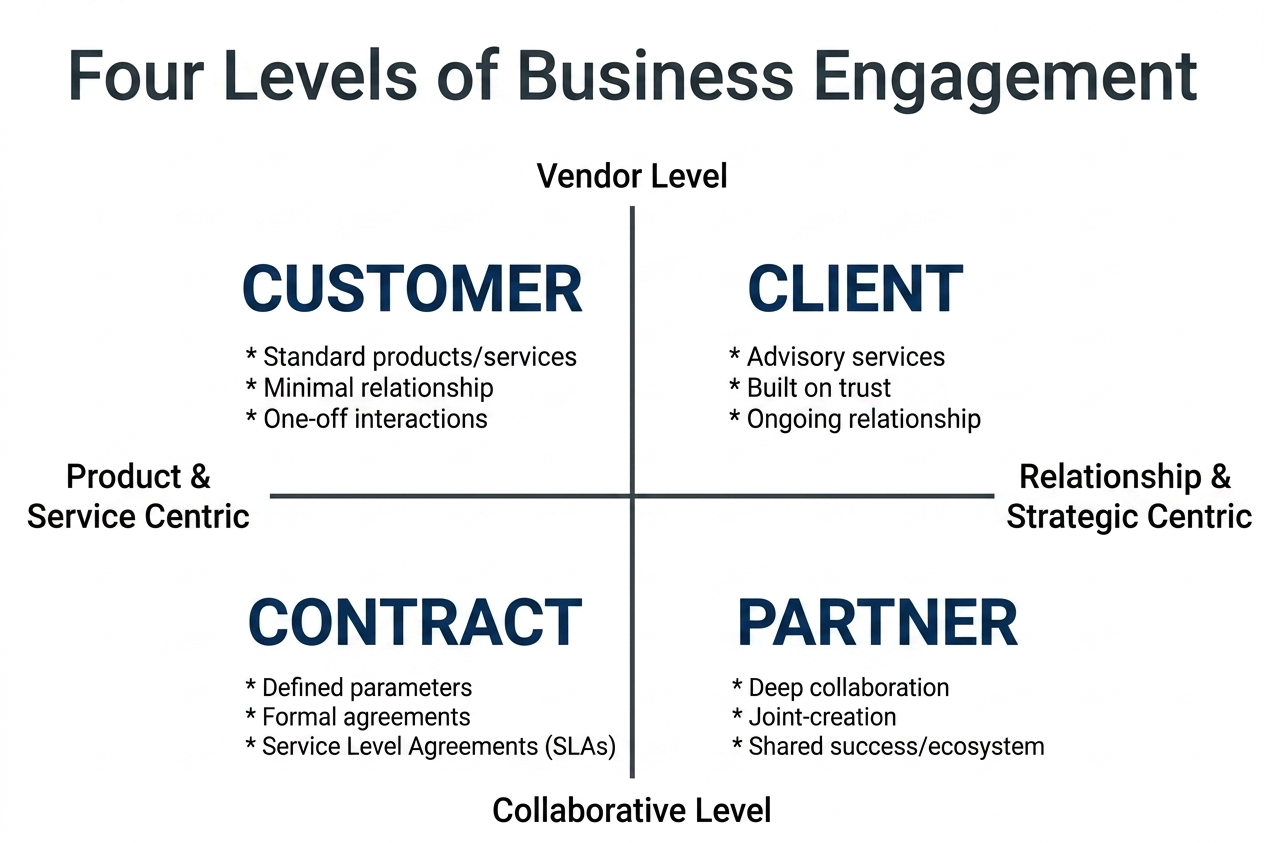
Customer → Client → Contract → Partnership
Think of it as a ladder.
The people at the bottom are giving you transactions.
As you move upward, the relationship becomes more deliberate, more repeatable and potentially more valuable to both sides.
That does not mean every customer should become a contract.
It means you should learn to recognise when a simple sale is actually the beginning of a much bigger commercial relationship.
And this applies whether you're selling wine, building websites, supplying phones, making clothes or running a cleaning company.
1. Customer: “I bought from you.”
A customer is usually buying a specific thing at a specific time.
Someone orders three bottles of wine for a birthday.
Someone buys an iPhone.
Someone orders a dress.
Someone pays you to clean their apartment.
Someone hires you to design a logo.
The transaction happens.
You deliver.
Done.
There's nothing wrong with that.
Your business needs customers.
But here's where many small businesses stop thinking.
They celebrate the sale and immediately start looking for another stranger to sell to.
That's where the ladder becomes useful.
Because sometimes the customer has already shown you something valuable.
They trust you.
They paid you.
They've experienced the quality of your work.
So the next question becomes:
What could make this relationship worth continuing?
That brings us to the second level.
2. Client: “I come back to you.”
A client relationship is more intentional.
They don't simply happen to buy from you again.
They choose your business repeatedly because they already understand the value you provide.
That difference matters.
Let's say you're selling wine.
A customer buys six bottles for a birthday party.
Good.
But after the event, you discover they also host dinners every month.
Now you have an opening.
Instead of waiting for them to remember you three months later, you could say:
“We stock regularly and can put together monthly selections based on what you usually buy.”
You've changed the conversation.
You're no longer just selling six bottles.
You're becoming the person they come to when they need wine.
The same thing works in other industries.
Digital services
Someone pays you ₦150,000 to build a website.
That's a customer.
But if they now need updates, maintenance, landing pages, content changes and technical support every month, there's a reason to turn that one project into an ongoing client relationship.
The next conversation isn't:
“Do you need another website?”
It's:
“Would it be easier if we handled the ongoing work for you?”
Different question.
Different business.
Clothes and fashion
Someone buys one outfit from your brand.
Don't immediately assume the next move is another random Instagram post.
Maybe they are buying for work.
Maybe they attend events regularly.
Maybe they're purchasing for a family.
Maybe they're a stylist who needs clothes for clients.
You don't discover that by posting harder.
You discover it by paying attention.
Gadgets and devices
Someone buys one laptop.
You could treat it as a finished transaction.
Or you could realise they're running a small company with 12 employees.
Now the customer isn't just a person who bought a laptop.
They're potentially a business client who will eventually need more devices, accessories, repairs and replacements.
The first sale just opened the door.
Local services
Someone books your cleaning service once.
Then again.
Then again.
At some point, they're no longer trying different cleaners.
You're their cleaner.
That's a client relationship.
And this is where things get interesting.
Because recurring revenue is valuable precisely because it gives a business more visibility into future income than sporadic one-off sales.
But you can climb higher.
3. Contract: “We've agreed to keep doing this.”
A contract changes the nature of the relationship.
Now there is a defined commercial commitment.
That might mean:
A six-month supply agreement.
A monthly service arrangement.
A yearly maintenance agreement.
A recurring order.
A minimum purchase commitment.
A fixed service scope.
The exact structure depends on the business.
Let's go back to wine.
Imagine you currently sell bottles to individuals.
Then a restaurant approaches you.
They don't want 10 bottles today.
They want regular supply.
Now you could keep treating every order like a fresh negotiation.
Or you could agree on supply terms, pricing, delivery schedules and payment arrangements.
That's a contract.
And suddenly your business has something much more useful than another Instagram customer.
It has committed demand.
Food business
A caterer sells lunch boxes to random individuals.
Then an office starts ordering 40 meals every weekday.
That's a completely different business opportunity.
The goal isn't to keep convincing 40 individual people to buy lunch every morning.
The goal is to become the office's regular food supplier.
One relationship.
A lot more transactions.
Digital services
A company pays you for one video.
Then asks you to handle 20 videos every month for six months.
Now you can structure the scope, deliverables, deadlines, payment terms and revision limits.
You aren't hoping they'll remember you next month.
You have an agreed engagement.
Cleaning company
One apartment is useful.
An office that requires cleaning three times a week for 12 months is a different level of business.
That contract changes how you plan staff, equipment, transport and cash flow.
You can make decisions with more confidence because the work is not purely dependent on tomorrow's enquiries.
Fashion
This one gets overlooked.
A fashion business doesn't have to sell only to individuals.
Imagine a clothing manufacturer supplying uniforms for a company, school or hospitality business.
That's no longer:
“One customer bought three shirts.”
It's:
“We've agreed to supply 400 shirts under specific terms.”
Your entire sales strategy starts looking different.
4. Partnership: “Let's build this together.”
Partnership is the top of the ladder, but it needs an important clarification.
It doesn't automatically mean forming a legal partnership company.
It means the commercial relationship has become strategically important to both sides.
The other business is no longer simply buying from you.
Both sides have a reason to make the relationship stronger.
A wine distributor works closely with an event company and becomes its preferred supplier.
A digital agency handles the marketing and technology for a growing brand and plans campaigns together.
A cleaning company manages multiple properties for a real estate operator.
A gadget supplier becomes the regular device procurement partner for a growing company.
A fashion manufacturer works directly with a retailer to develop products for its customer base.
That's different from simply having a big customer.
There's coordination.
Planning.
Trust.
Shared incentives.
Sometimes even shared resources.
Formal business partnerships can also give companies access to capabilities, experience and market reach they wouldn't have alone. The U.S. Small Business Administration, for example, highlights shared costs, resources, experience and market access as some of the benefits of structured joint ventures.
The important idea is simple:
You stop asking, “What can I sell them?”
And start asking:
“What can we build together?”
So how do you actually move people up the ladder?
Don't force it.
Look for signals.
A customer keeps buying the same thing.
That's a signal.
A customer starts asking about larger quantities.
Signal.
A customer asks whether you can supply them regularly.
Big signal.
A customer introduces you to another business.
Another signal.
The mistake is treating every purchase as isolated.
Keep records.
Notice patterns.
Ask better questions.
When someone buys from you repeatedly, don't just say thank you and disappear.
Ask:
“What do you normally use this for?”
“How often do you need it?”
“Do you buy this elsewhere too?”
“What usually makes this difficult for you?”
Those questions can reveal a completely different opportunity.
The five businesses we started with all climb the ladder differently
Wine and food
Customer: Orders for an event.
Client: Regular personal buyer.
Contract: Office, restaurant or event company places recurring orders.
Partnership: You become a preferred supplier and help plan their recurring needs.
Digital services
Customer: Buys one website, logo or video.
Client: Continues using you for ongoing work.
Contract: Monthly or annual service agreement.
Partnership: You become part of their growth or marketing operation rather than just an external vendor.
Gadgets and devices
Customer: Buys one phone or laptop.
Client: Returns for accessories, upgrades or more devices.
Contract: Company uses you as an ongoing equipment supplier.
Partnership: You become a dependable procurement or technology partner.
Clothes and fashion
Customer: Buys one outfit.
Client: Returns regularly.
Contract: You supply uniforms, retail stock or recurring corporate orders.
Partnership: You work with a retailer, brand or organisation on ongoing product development or supply.
Local services
Customer: Books one cleaning, laundry or dry-cleaning job.
Client: Uses you repeatedly.
Contract: You service an office, estate, hotel or property portfolio on an agreed schedule.
Partnership: You become the operator's trusted service provider across multiple locations or ongoing needs.
Same ladder.
Different business.
Here's where most businesses get stuck
They keep trying to move sideways.
More customers.
More customers.
More customers.
But they rarely try to move up.
A fashion seller with 500 customers may be thinking:
“I need 500 more.”
A smarter question could be:
“Are any of these 500 people actually businesses?”
A food vendor might be thinking:
“I need more Instagram followers.”
A better question:
“Which offices around me could order lunch every weekday?”
A web designer might be thinking:
“I need another client.”
Maybe.
But perhaps the last five projects are all from companies that need ongoing support.
A cleaning business might spend money advertising to households while a property manager nearby needs a reliable cleaning team for 20 apartments.
The opportunity is not always hiding somewhere on the internet.
Sometimes it's sitting inside your existing customer base.
Don't skip straight to contracts
There's another mistake worth avoiding.
A contract isn't automatically better just because it is a contract.
A bad contract can trap you in bad pricing, unrealistic delivery requirements or unprofitable work.
Before accepting recurring business, understand:
How much does it cost to fulfil?
How often will you be paid?
Who carries the risk?
What happens when costs change?
What happens when either side wants to leave?
What exactly are you promising?
A ₦5 million contract that costs you ₦4.9 million to fulfil is not automatically better than ten smaller customers with healthy margins.
Predictability matters.
So does profitability.
The real goal is not to have fewer customers
This isn't an argument against selling to individuals.
Individual customers can become the foundation of the entire ladder.
The point is to stop thinking about every sale as the final destination.
A customer can reveal demand.
A client can reveal repeat behaviour.
A contract can create predictability.
A partnership can create deeper commercial value.
And the higher you go, the more important your systems become.
You need proper records.
Clear pricing.
Reliable fulfilment.
Professional invoices.
Order management.
Payment tracking.
Customer history.
And eventually, a way to manage the whole relationship without keeping everything inside your head or scattered across WhatsApp chats.
That's where a proper commerce system becomes useful.
Not because every business needs some fancy setup.
Because once customers start becoming clients and contracts, losing information becomes expensive.
So look at your business differently this week
Don't just count how many customers you have.
Sort them.
How many bought once?
How many have bought repeatedly?
How many could realistically buy from you every month?
How many are businesses?
How many could need larger quantities?
How many are already asking for ongoing arrangements?
Then ask one more question:
What would I have to offer for one of these customers to become a client, a contract or eventually a partner?
You might discover that your next stage of growth isn't hiding in a new advert.
It may already be sitting in your customer list.
Because the best sale isn't always the one that happens today.
Sometimes it's the one that quietly creates business for the next twelve months.