
Someone bought from you last month.
They liked the product.
They paid.
You delivered.
Everything went fine.
So why haven't they bought again?
Most businesses don't really ask this question.
They just go looking for another customer.
Another advert.
Another influencer.
Another post.
Another ₦50,000 spent trying to convince somebody new to buy.
Meanwhile, the person who already trusted you enough to spend money is sitting somewhere in their phone, completely forgotten.
That's an expensive habit.
The first sale is only half the relationship
A first purchase tells you something important.
The customer was willing to trust your business.
They were willing to part with their money.
They were willing to wait for delivery.
They experienced the product.
That's valuable information.
You already crossed the hardest psychological barrier: getting a stranger to become a customer.
But many businesses treat that customer as if they became a stranger again the moment the order was delivered.
No follow-up.
No reason to return.
No reminder.
No new product recommendation.
Nothing.
Then three months later, the business starts advertising aggressively for new customers.
That is backwards.
Retention isn't just sending “Hello dear”
This is where customer retention advice often becomes useless.
“Send personalised messages.”
“Improve customer service.”
“Build relationships.”
Okay.
But what does that actually mean?
If someone bought skincare from you, a useful follow-up might be asking how the product worked for them or reminding them when they're likely to need another one.
If they bought food, you could introduce the next menu or give regular customers early access.
If they bought clothes, you might show them something that genuinely matches what they already purchased.
The point isn't to message customers more.
It's to give the message a reason to exist.
Your customer history is more valuable than you think
Imagine two businesses.
Both have 1,000 customers.
Business A knows:
“1,000 people have bought from us.”
Business B knows:
“230 bought in the last 30 days, 410 haven't bought in six months, 180 usually buy every two months, and 95 customers have bought more than five times.”
They have the same number of customers.
They do not have the same amount of information.
Business B can actually make decisions.
It knows who is active.
Who is drifting away.
Who buys frequently.
Who spends the most.
Who might be ready for another purchase.
That is why customer records matter.
A recent Nigerian ecommerce retention guide highlighted scattered customer records and inconsistent follow-up as practical reasons businesses struggle to turn first-time buyers into repeat customers.
And no, the answer isn't always another discount
This is important.
If your only reason for getting someone to return is:
“20% OFF IF YOU BUY AGAIN!”
then you may not actually be building loyalty.
You may simply be buying another transaction.
Sometimes a customer returns because the product was excellent.
Sometimes because delivery was smooth.
Sometimes because you remembered what they like.
Sometimes because ordering from you is simply easier than finding another seller.
Convenience is underrated.
If a customer already knows what you sell, trusts your payment process and has had a good experience, coming back should feel easier than starting from scratch with another business.
That's a competitive advantage.
The best retention strategy might be hidden inside your product
Think about what you're selling.
Does it naturally run out?
Does it need replacing?
Can customers buy another version?
Can they add something to their original purchase?
Can they upgrade?
Can they refer someone?
Can they come back for another service?
If yes, your business already has a reason for repeat purchases.
You just need to build around it.
For products people regularly consume, repeat purchasing is naturally easier to create than for one-off products. Ecommerce retention data consistently shows higher repeat behaviour among categories where customers regularly need replenishment.
That means the business shouldn't just ask:
“How do we sell this?”
It should also ask:
“What happens after they finish using it?”
That's where the next sale often lives.
Here's a simple experiment
Take the last 50 customers who bought from you.
Put them into three groups:
Bought once.
Bought more than once.
Bought recently but haven't returned when they normally would.
Now look at them differently.
Don't ask how to sell to all 50.
Ask why each group behaves differently.
What made the repeat customers come back?
What happened to the one-time buyers?
What changed with the customers who stopped buying?
You may find that your biggest growth opportunity isn't another 500 strangers.
It might be the 50 people who already know your name.
A business should remember its customers
That's really what retention comes down to.
Not annoying people.
Not sending endless promotions.
Not begging customers to buy again.
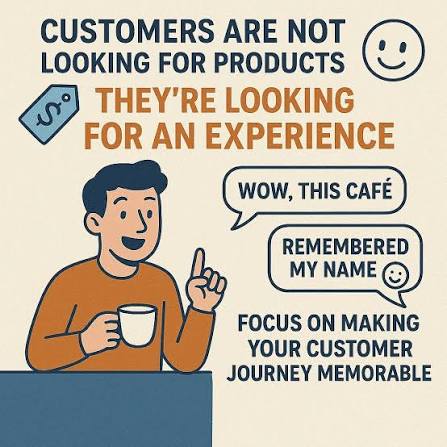
Remembering them.
Remembering what they bought.
Understanding when they might need you again.
Giving them a better reason to return.
Making the second purchase easier than the first.
Because if you keep spending money to acquire customers who buy once and disappear, your business is constantly starting from zero.
And businesses that constantly start from zero have to work much harder just to stay in the same place.
The better goal isn't simply to keep finding customers.
It's to build a business that customers remember to come back to.